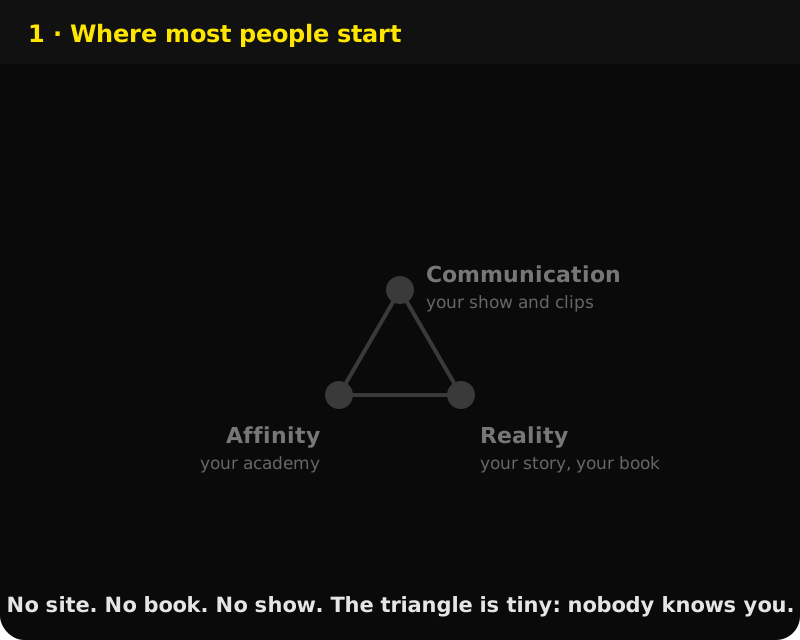
This is the whole idea behind everything we are building with you, in one lesson. It is the most important lesson in your 14 days, so take your time with it.
Look up the word fame on Google and this is what comes back:
Fame is the state of being widely known, recognized, or talked about by a large number of people, usually because of one's achievements, skills, or public presence.
Break that down. To be famous, people have to:
• Know you. Widely known: a lot of people know who you are.
• Recognize you. They know your face and your name when they see them.
• Talk about you. They tell other people about you.
And the definition says why they know you. Because of three things:
• Your achievements. People know what you have done.
• Your skills. People know what you can do.
• Your public presence. People can actually see you, and see that other people follow you.
So fame is not luck. Fame is knowingness. The more people know what you have done and what you can do, and the more they can see you, the more famous you are.
That is the end result we want for you, because you believe, and we believe, the world should know you. Most people wait for it: for luck, for a company, for a network to pick them. We do not wait. We decide fame is the result, then build every piece of it ourselves, on purpose.
How we build it: three websites, each doing a different job, and traffic driven to all three. Getting known is the step. The ARC triangle is exactly how it is done.
There is a simple law about people. The more someone likes you, the more real you are to them, and the more you two talk, the more they understand you. Raise all three together and understanding goes up. We call it the ARC triangle: Affinity, Reality and Communication.
Picture a triangle. Communication sits at the top. Affinity is on the bottom left. Reality is on the bottom right. Raise any one corner and the other two rise with it.
• C · Communication is any message that goes from one person to another.
Calling and talking to a friend. Posting on social media. Sending an email. The more communication there is, the higher the chance that reality and affinity go up too.
For you, communication is your reality show and the clips cut from it, on every social account you have. It is the corner that gets attention.
• R · Reality is shared reality: a common understanding about a topic, an idea or a person.
Liking the same music. Following the same football team. Even disliking the same politicians. Two strangers who agree on one thing already feel closer.
For you, reality is your story, shared in the format everyone already understands, the hero's journey, so the reader or viewer sees you as a hero right away. It lives in your book and your personal site, live or written down so anyone can find it later. It is the corner that sells and educates.
• A · Affinity is the willingness to be close to someone.
The difference between a handshake and a kiss. Between watching someone for free and paying them. The more time or money someone gives you, the higher the affinity.
For you, affinity is your academy, where people pay to get closer to you and learn to be like you. It is the corner that delivers.
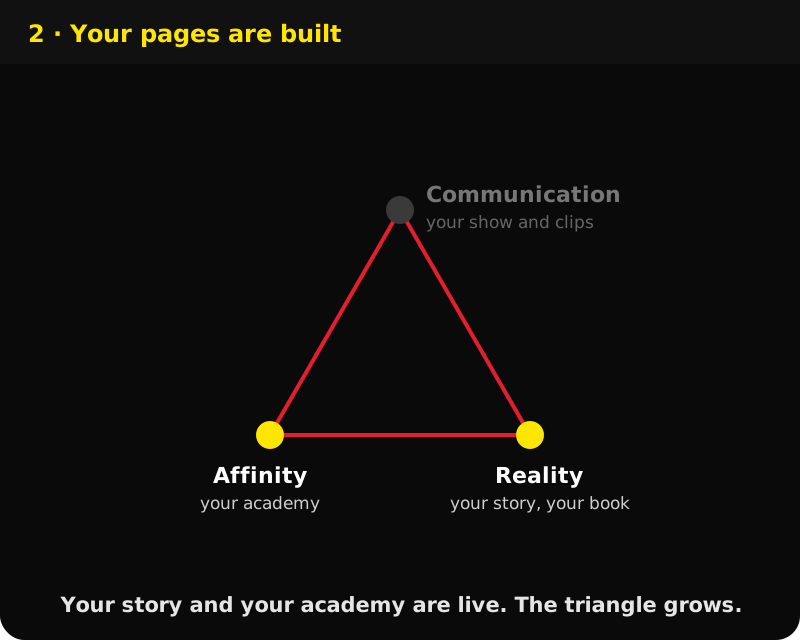
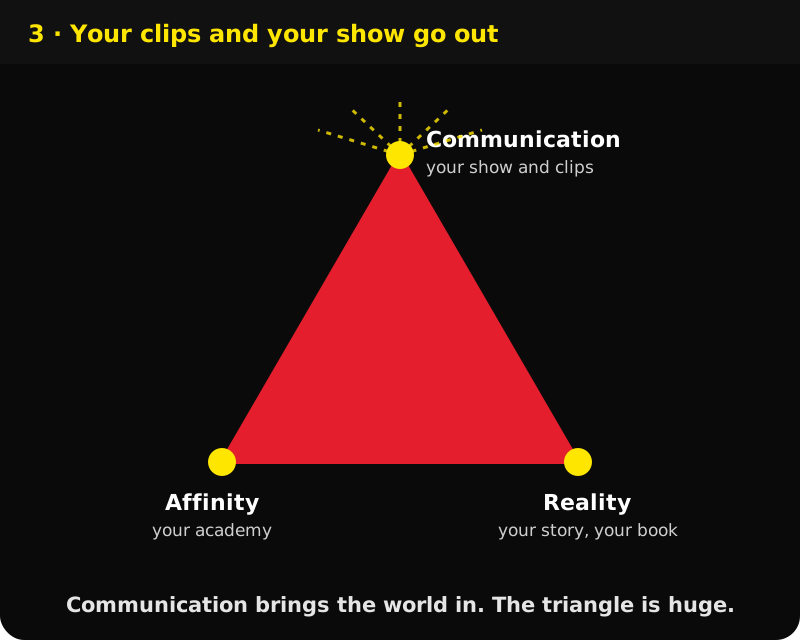
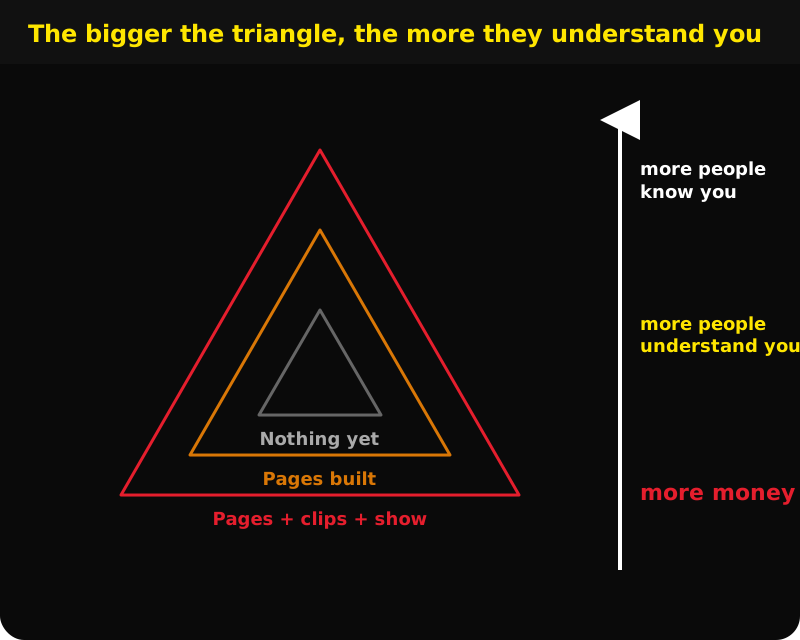
Followers alone do not make a big triangle. The size comes from all three corners together. Here are five people:
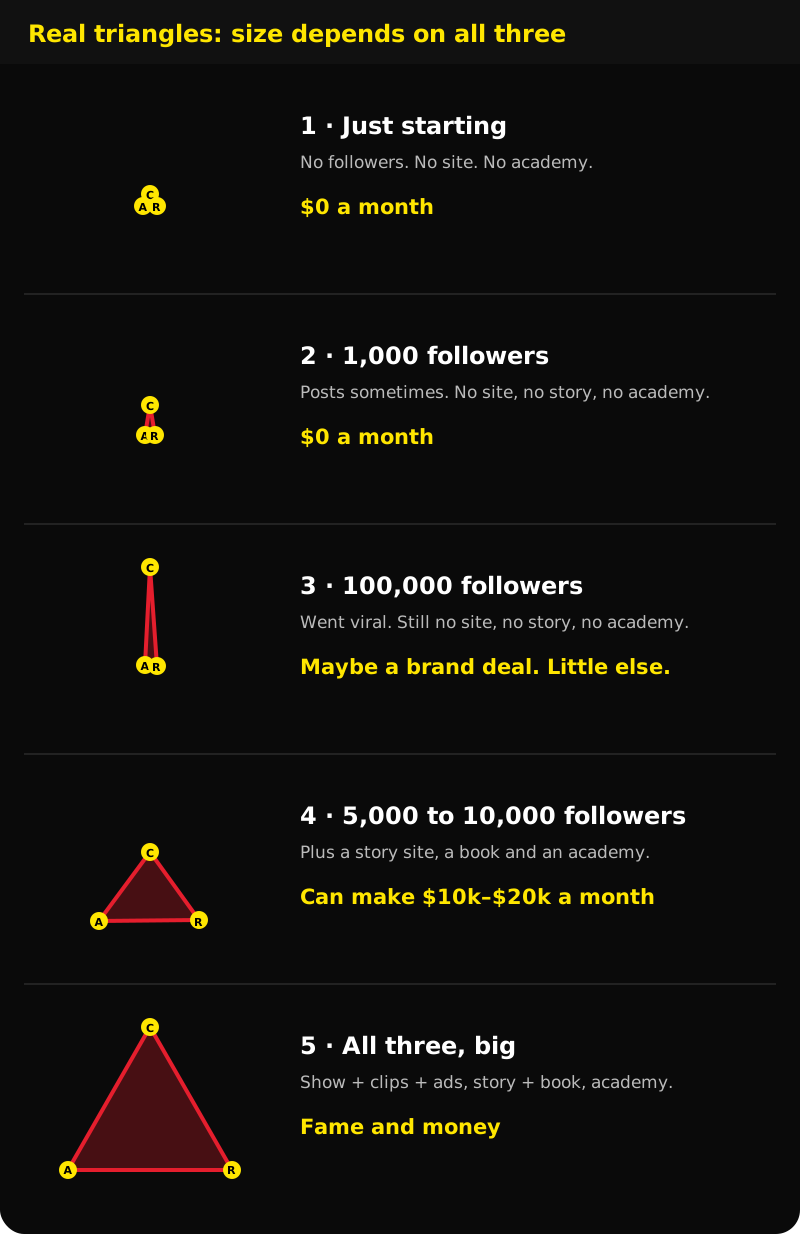
• 1 · Just starting. No followers, no site, no academy. A dot. Nobody knows them yet.
• 2 · 1,000 followers. A little communication, nothing else. A small sliver.
• 3 · 100,000 followers. Huge communication, but no reality and no affinity. A tall, thin spike: famous-ish, and still broke.
• 4 · 5,000 to 10,000 followers, plus a story site, a book and an academy. Smaller audience, balanced triangle. People like this can make $10,000 to $20,000 a month, because the people who find them understand them and have somewhere to go.
• 5 · All three, big. Show, clips and ads; story and book; an academy. That is fame and money together.
Results like number 4 are possible, not promised. It depends on the work, the offer and the market. What it shows is the rule: a balanced small triangle beats a lopsided big one.
The goal is not more followers. The goal is a bigger, balanced triangle. That is exactly what we are building with you.
Look at anyone the whole world feels it knows, and you will find all three corners.
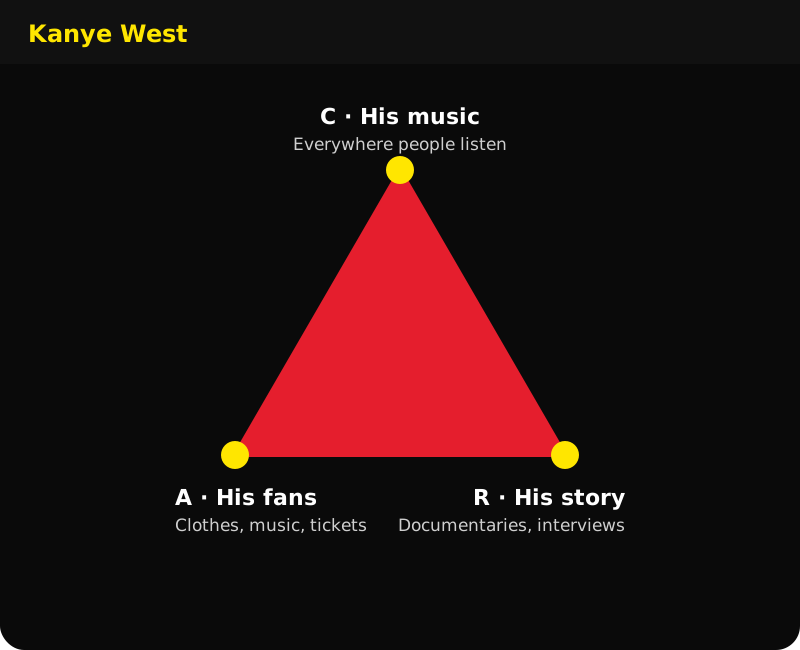
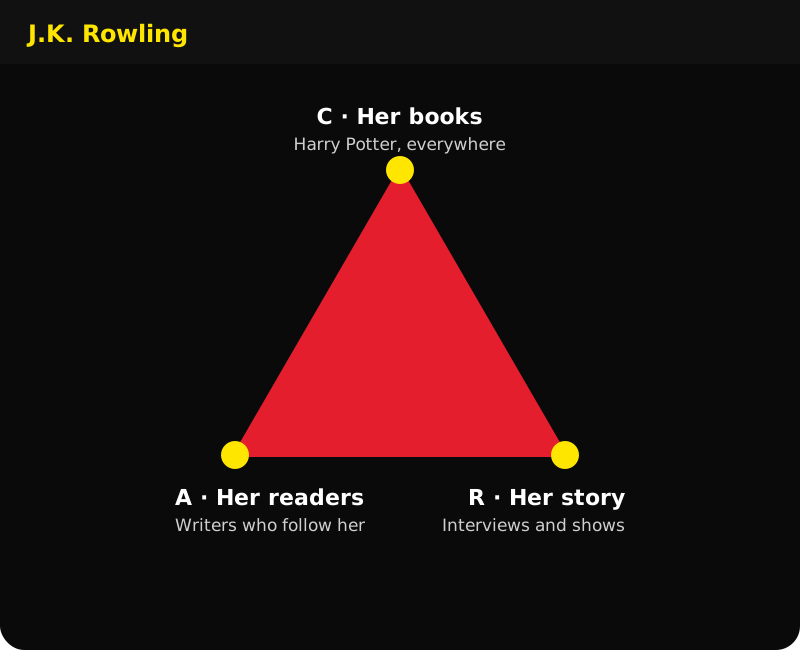
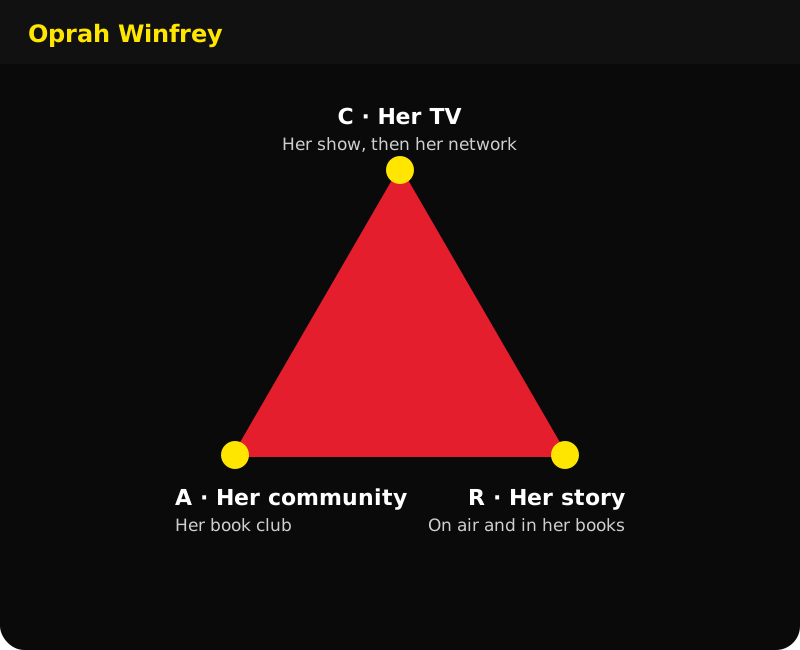
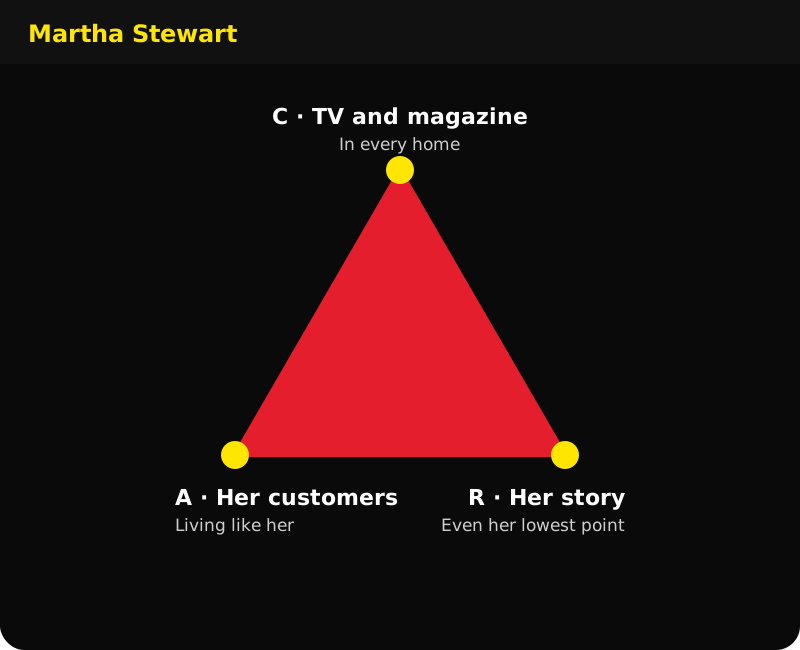
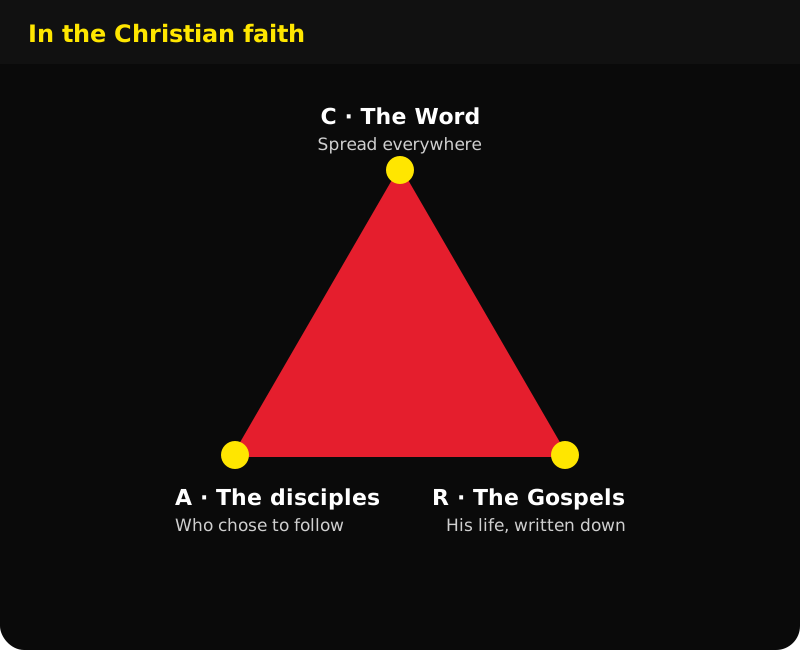
Being known is not the same as getting paid. If one corner of the triangle is missing, the money does not come. Here is what happens when each one is gone:
• No affinity (no academy). Someone goes viral and gets a flood of followers, but there is nothing to join and nothing to buy. Lots of attention, no way to turn it into money. The fame fades and the bank account stays the same.
Like a creator with millions of views and nothing in the link in their bio.
• No reality (no book, no story, no site). You are great, maybe one of the best in the world at what you do, but there is no website telling people who you are and showing your history and your work. People hear about you, look you up, find nothing, and doubt it.
Like someone who says they founded a famous company, but there is no Wikipedia page, no story, nothing to check. Without proof, nobody believes it.
• No communication (no platform, no ads). People go to certain places to find the best of anything. You are not there, and you are not paying to be seen there, so they never find you.
Like the Beatles not being on Spotify: the greatest music in the world, missing from the place everyone goes to listen.
Now put all three together. Someone goes viral. Then they have a book that tells their story and how they do this great thing. People read it and want to be like them. Now they are willing to pay, and the academy is there to take them in. They get the fame, the money, and the followers who become disciples. That is why we build all three for you, at the same time.
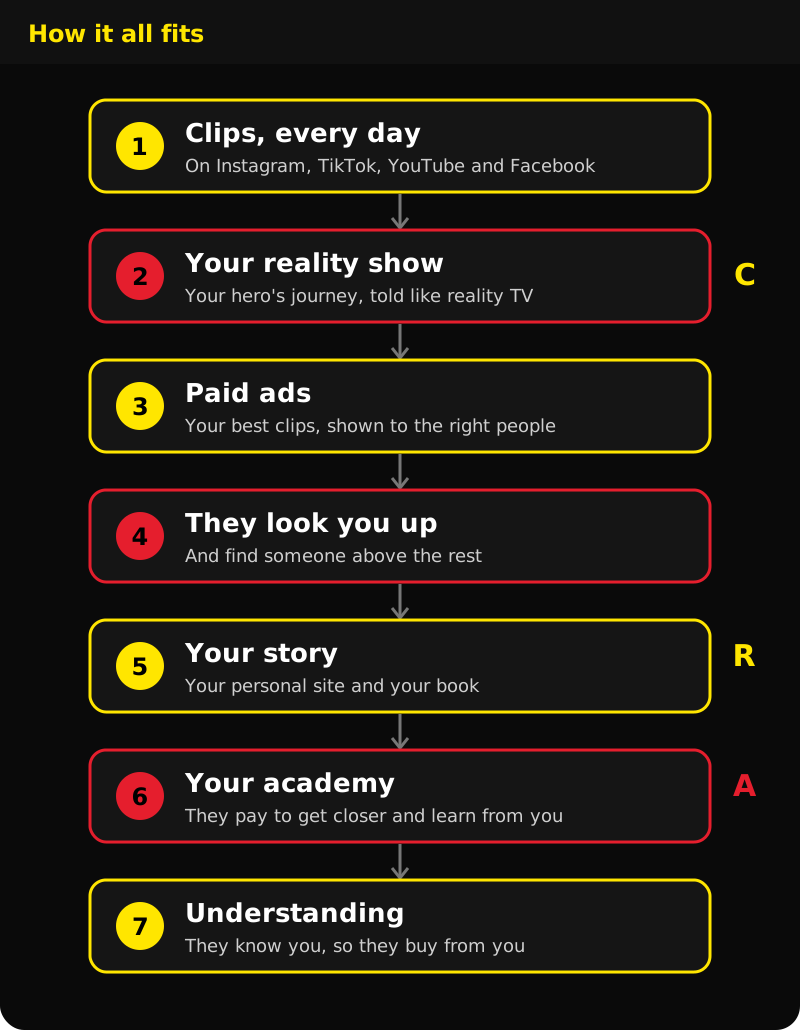
Your reality show is how you tell the world who you are, and show it: you, as the hero, going through your own hero's journey, told like reality TV.
The clips we make from it go out every day on social media and drive people to your show. Then paid ads put your best clips in front of the right people.
Why does watching a reality show make people feel they know you? Because they see you good and bad.
When you know something bad about a person, it breaks the wall of fakeness. Everyone online looks perfect, and nobody believes perfect. One honest flaw, even one that is planned, tells the viewer: this is real.
That is what your shard of glass is for. We show them, on purpose: here is a way I am not perfect. It is one of the most important parts of your show.
Here is why it works. The brain says: I know bad things about the people closest to me in my life. So when it knows something bad about you, it puts you right next to them. Then the viewer gets to see all your good: your wins, your skills, the way you help people.
That creates a parasocial relationship. Once someone has watched enough of your content, they genuinely feel they have a personal relationship with you, as if you were a real person in their life. They have never met you, but they know your face, your voice, your story, your flaws and your wins. That feeling is what makes them look you up, trust you, and want to get closer.
The people who see those ads look you up. What they find is someone above the rest: your personal site with your story, your book, and your show.
Because they now understand you, they want to get closer. Our systems and automation take them from there into your academy, where they pay to learn from you.
That is how it all fits: your personal site and your story are your reality, your reality show site and your clips are your communication, and your academy is your affinity. Whichever one a stranger runs into first, the other two are right there.
Yes, we use a sales funnel. We use the M.AS.T.E.R offer, real deadlines and the other tools of persuasion to get people to act. Here is why that is not a trick played on them.
What drives it is their own want: they want to be like the hero, like you. The trouble is that a person's own mind talks them out of what they want. It says wait, it costs too much, people like me do not do that. That is self-sabotage, and it keeps most people exactly where they are.
So the funnel and the offers are there to help them get past their own doubt: to find the guts to pay, to cross the threshold, and to become someone who is great. We are not making them want it. They already do. We are helping them do it.
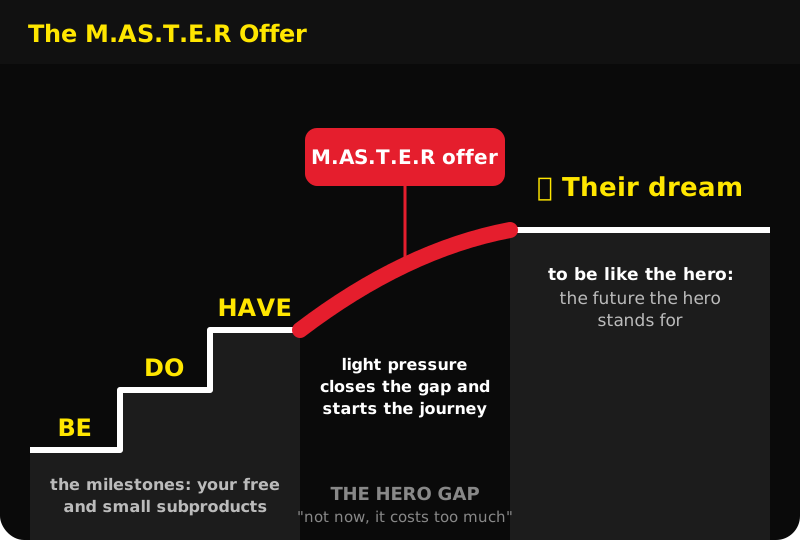
That is the light pressure in the M.AS.T.E.R offer: a real deadline and a price low enough to say yes today. It is the missing step over the gap. What it really says is: buy this now and cross over, or stay where you are and do not reach your dream. Put that way, people choose to buy, because they want their dream more than they want to keep waiting.
And when they do pay, they have proven something about themselves. Someone willing to let go of their time, their money and their effort for the chance to get what they want has shown they are destined for greatness. That was true for you when you said yes, and it will be true for every person who says yes to you.
Now read the definition again: widely known, recognized and talked about, because of your achievements, your skills and your public presence. Here is how each part gets built:
• Public presence = your reality show. People can see you, every day, on your network and on every social account.
• Achievements = your story, your book and your site. People know what you have done, told as a hero's journey.
• Skills = your academy. People learn what you can do, and they follow you.
• Traffic to all three. Three websites, one for each corner, with ads and clips sending people to every one of them.
That is how we create fame on purpose, instead of waiting for it.
Take the check. There are 29 questions and you need 23. This one matters, so take your time.
Why: Widely known, recognized and talked about, because of achievements, skills or public presence.
Why: Fame is how many people know what you have done, what you can do, and can see you.
Why: People know what you have done, what you can do, and they can see you.
Why: Most people wait. We do not.
Why: We start with the end result and create the elements ourselves, on purpose.
Why: Three properties, one per corner of the triangle, and traffic to all of them.
Why: The show is how people see you. That is public presence.
Why: The academy shows your skills, and the people who follow you.
Why: They already want it. Their own mind talks them out of it. The funnel helps them cross the threshold.
Why: Letting go of time, money and effort for the chance to receive it is what people destined for greatness do.
Why: Reality is shared understanding. The hero's journey is the format everyone already understands.
Why: They have never met you, but they feel they know you. That is why they look you up and want to get closer.
Why: Being known is not the same as getting paid. You need all three corners.
Why: Lots of attention with nothing to join means no way to turn it into money.
Why: Great work that nobody sees is missing communication: the platform and the push to get it seen.
Why: C at the top, A on the left, R on the right.
Why: Agreeing on something is shared reality, and it pulls the other two corners up with it.
Why: We know bad things about the people closest to us. Knowing one about you puts you next to them.
Why: A balanced small triangle beats a lopsided big one. Followers are only one corner.
Why: Affinity, Reality, Communication. Raise all three and understanding goes up.
Why: The bigger the triangle, the more people know you. The more they understand you, the more money you make.
Why: Almost everyone starts with nothing on the triangle. That is why we build each corner.
Why: The show and the clips are your platform. They bring the world in.
Why: Reality is shared understanding: your story, live or written down, so anyone can find it later.
Why: Affinity is the people who give your idea energy: time, support and money.
Why: The music is communication, his story is reality, and the people paying to be closer are affinity.
Why: Her books are how she reached the world. Her story is reality, and her followers are affinity.
Why: Ads send people to look you up. What they find decides whether they come closer.
Why: Understanding comes first. Once they know you, they want more of you.